

Dynamic Cross-Flow Filtration (DCFF)
More efficient filtering, minimal energy consumption
Principle of rotation filtration
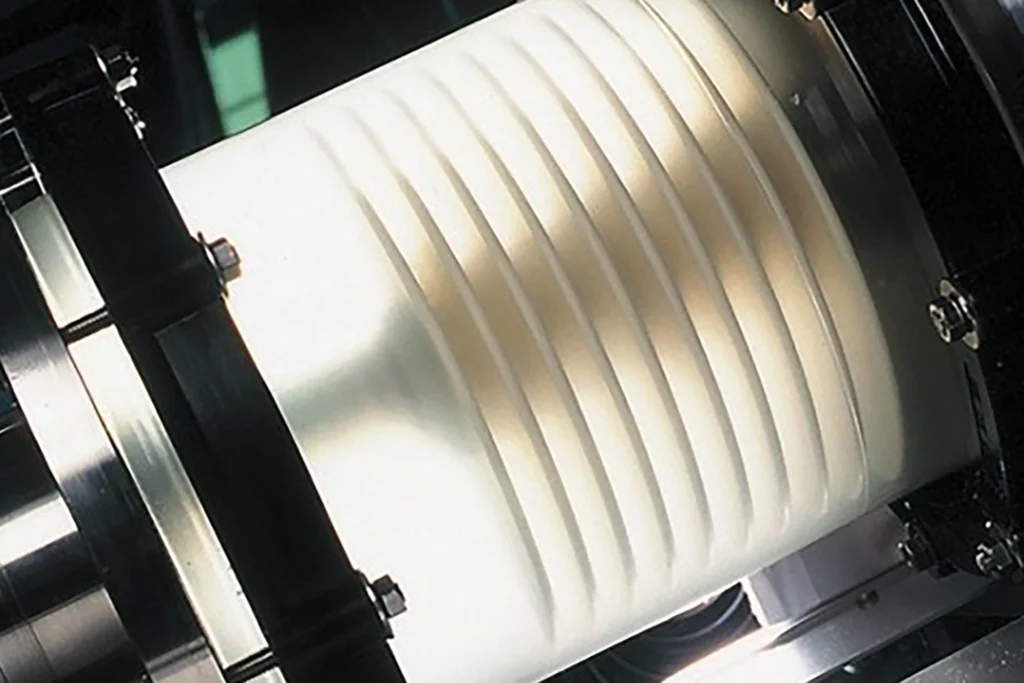
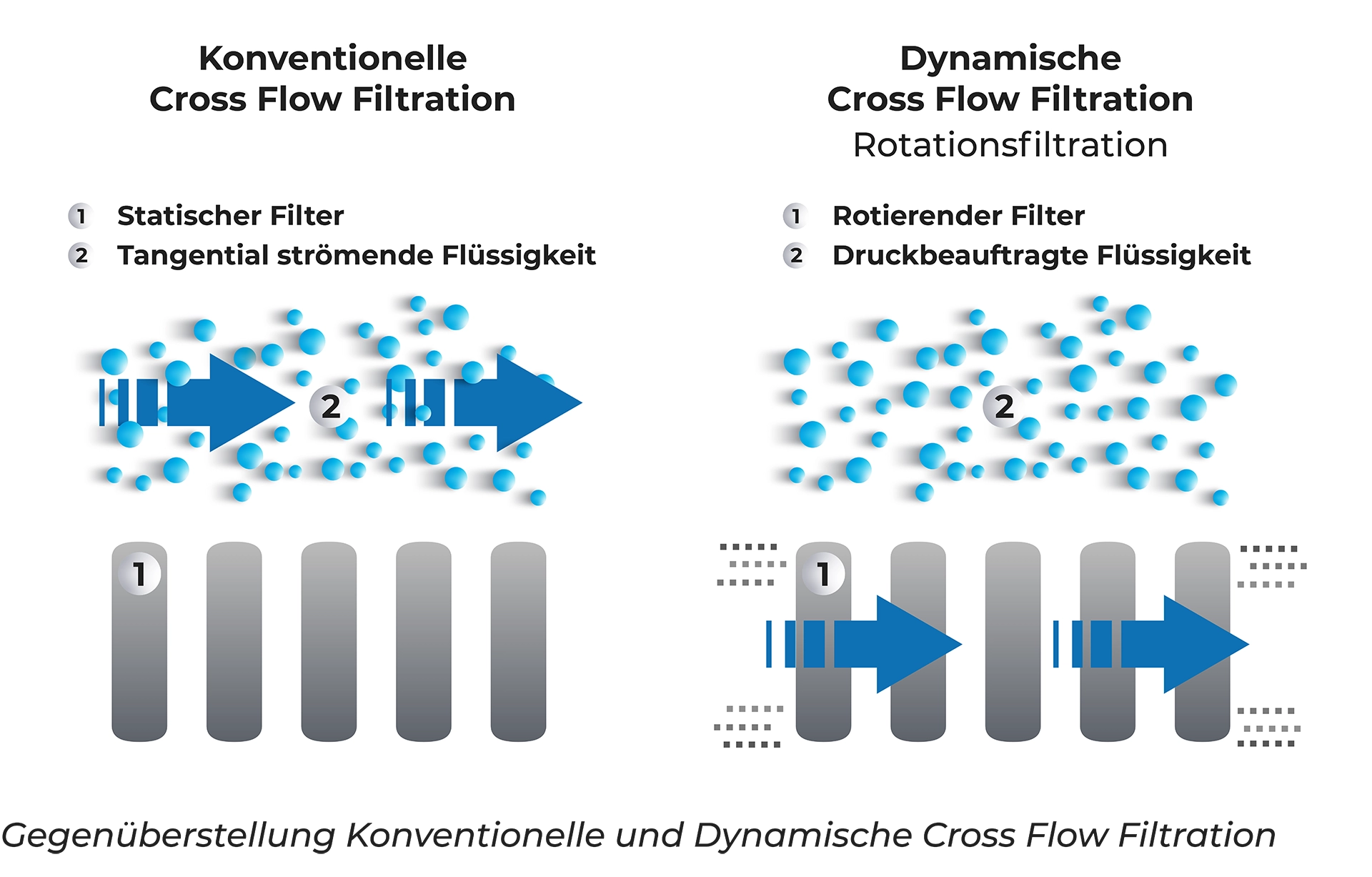
DCFF is an innovative form of membrane filtration in which the membrane itself is set in motion.
While traditional crossflow systems require high pump capacities to generate flow along the membrane, in DCFF a rotating ceramic membrane disc performs this task.
The rotation creates intense cross-flow currents directly at the surface. These prevent particles or solids from depositing on the membrane—the membrane remains “clean,” the flow remains stable, and energy consumption is low.
The result: high performance with low operating costs, even when handling viscous, highly concentrated, or sensitive media.
Today, DCFF is used in the chemical, environmental, food, and ceramics industries—anywhere efficient separation processes are required.
In short: DCFF uses motion instead of pressure to make filtration more efficient.
Why is DCFF worth it?
DCFF is an attractive option for anyone who wants to transport liquids and solids separately:
- Higher yields and a lower risk of fouling
- Lower energy consumption compared to conventional cross-flow processes
- Can also be used with viscous media or high solids content
Operating Principle / Technical Details
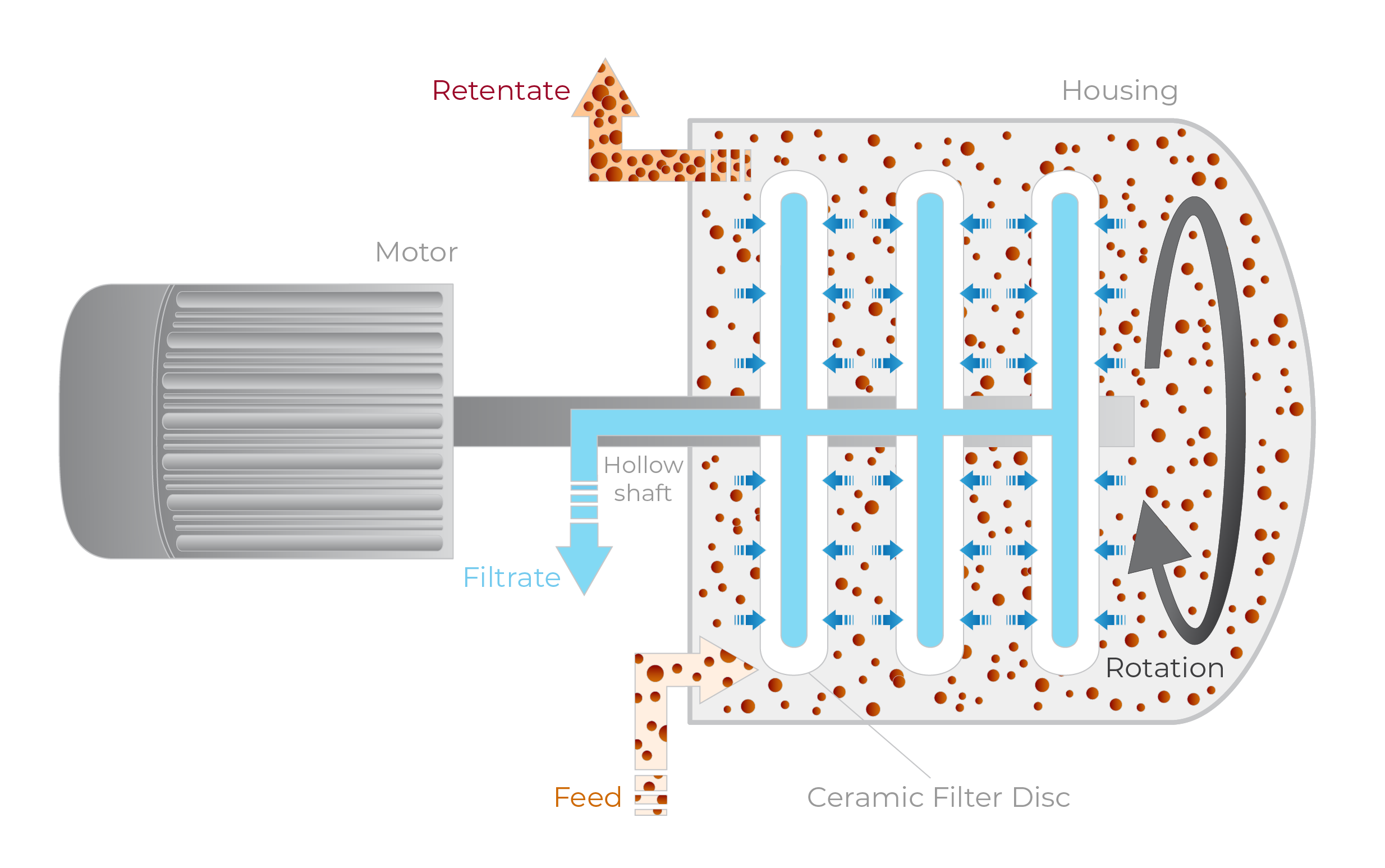
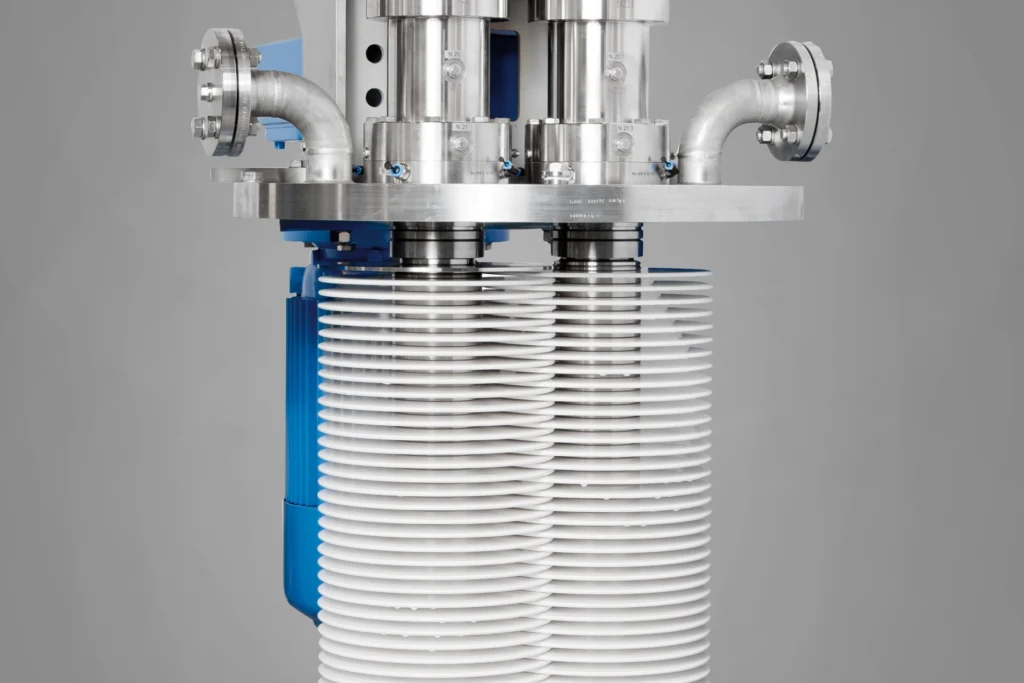
The ceramic filter discs are mounted concentrically on one or more hollow shafts that rotate inside a pressurized housing. The discs themselves have internal drainage channels. Filtration proceeds from the outside to the inside: the transmembrane pressure forces the filtrate through the membrane into the channels, where it is discharged via the hollow shaft.
The rotation generates tangential flow (cross-flow), which reduces local concentration polarization and deposits (filter cake). This keeps the membrane surface clear for longer and ensures consistently high flow rates.
Process Modes:
DCFF supports all standard operating modes: single-pass, batch, fed-batch, and feed-and-bleed (depending on the system configuration).
Video: DCFF
Your Benefits with DCFF
Advantages over conventional methods:
| Advantage | Description |
| Lower Energy Consumption | Since the cross-flow movement is generated by rotation rather than by high flow rates, energy consumption is significantly reduced. |
| Higher Flow Rates & Stability | The membrane surface stays clean longer, as shear forces dislodge deposits. |
| High concentrations are possible | Operation remains stable even with media that have a high solids content or high viscosity. |
| Durability & Robustness | Ceramic membranes are chemically and thermally resistant and can be backflushed or sterilized. |
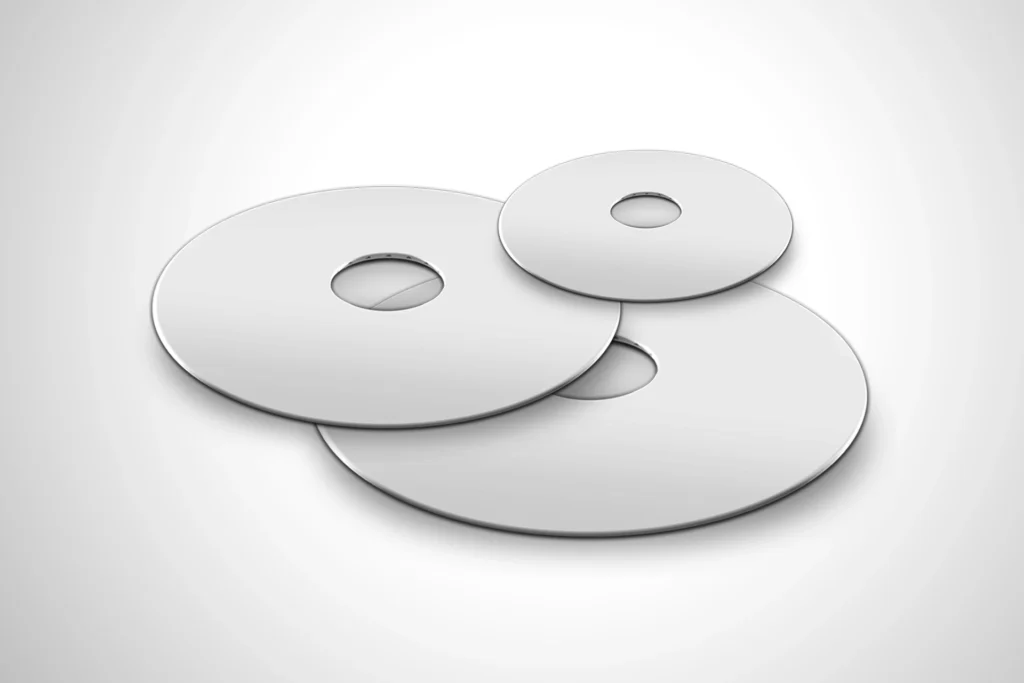
374mm, 312mm, 152mm
Key Factors and Limitations
The efficiency of dynamic cross-flow filtration is determined by several process parameters. Rotational speed, transmembrane pressure, and medium properties directly affect flow rate, stability, and energy consumption. Careful adjustment of these factors enables optimal filtration results—and at the same time reveals the physical and design limitations of the system.
Key Parameters:
To get the most out of the DCFF’s performance, the interaction of key process parameters is crucial. These parameters determine the efficiency, stability, and cost-effectiveness of the filtration process.
- Rotational speed – affects tangential shear forces
- Transmembrane pressure (TMP) – the pressure difference that drives the filtrate
- Solid Content / Viscosity – Affect Hydraulic Efficiency
- Pore Structure & Membrane Material – e.g., Microfiltration vs. Ultrafiltration
Limitations & Challenges:
- Mechanical Limits at Very High Rotational Speeds
- Balance Between Shear Force and Material Stress
- Sealing and Waterproofing Concepts
- Initial Costs vs. Cost-Effectiveness for Small-Scale Systems
Where is DCFF used?
DCFF can be used in many different areas. Here are a few examples:
- Environmental Technology & Water Treatment
- Process and Wastewater Treatment
- Biogas / Digestate Treatment
- Chemical & Pharmaceutical Industry
- Food & Beverages (e.g., fruit juices, fermentation processes)
- Aquaculture (oxygen supply via membrane aeration)
- Ceramics Industry (Concentration of Glaze Suspensions) – see the case study “Processing of Ceramic Suspensions” by KERAFOL®
Case Studies
Processing of ceramic suspensions using Dynamic Crossflow Filtration (DCFF)
Efficient oxygen supply in fish farming
Sustainable Manure and Digestate Treatment through Innovative Filtration Technologies
Technical Data & Specifications
| Data Set | Value / Range | Note |
| Disc diameter | 374 mm, 312 mm, 152 mm | Typical sizes for KERAFOL® KERAFOL®+1 |
| Diaphragm area per disc | ~0.20 m² (for Ø374) | depending on the KERAFOL® membrane configuration |
| Max. Transmembrane Pressure | up to ~2.5 bar | often sufficient for DCFF processes: KERAFOL®+1 |
| Pore Size / Filtration Range | Mikrobis Ultrafiltration | depending on coating / material selection KERAFOL®+1 |
| Materials / Membrane Materials | Ceramics (e.g., Al₂O₃) | High chemical / thermal resistance |
| Operating temperature range | depending on the materials | can be customized |
FAQs / Frequently Asked Questions
- Is DCFF also suitable for very low-viscosity fluids?
Yes—the rotation allows for effective cross-flow even at low viscosities.
- How often does it need to be backwashed or cleaned?
That depends on the medium, solids content, and operating parameters. In many applications, periodic backflushing or hot-steam sterilization is sufficient.
- How much energy is required compared to conventional cross-flow filtration?
In typical cases, it is significantly lower, since large pump volumes are avoided.
- Can I scale my systems later?
Yes—you can plan for upscaling based on the test run data. KERAFOL® provides you with suitable parameters for plant construction.
- Are there any restrictions regarding chemicals or temperatures?
The membranes are made of ceramic and are highly durable, but the choice of material and the seals must be checked for use in extreme conditions.
Test Facilities / Pilot Projects
Not sure if DCFF will work for your process?
No problem—rent a test system:
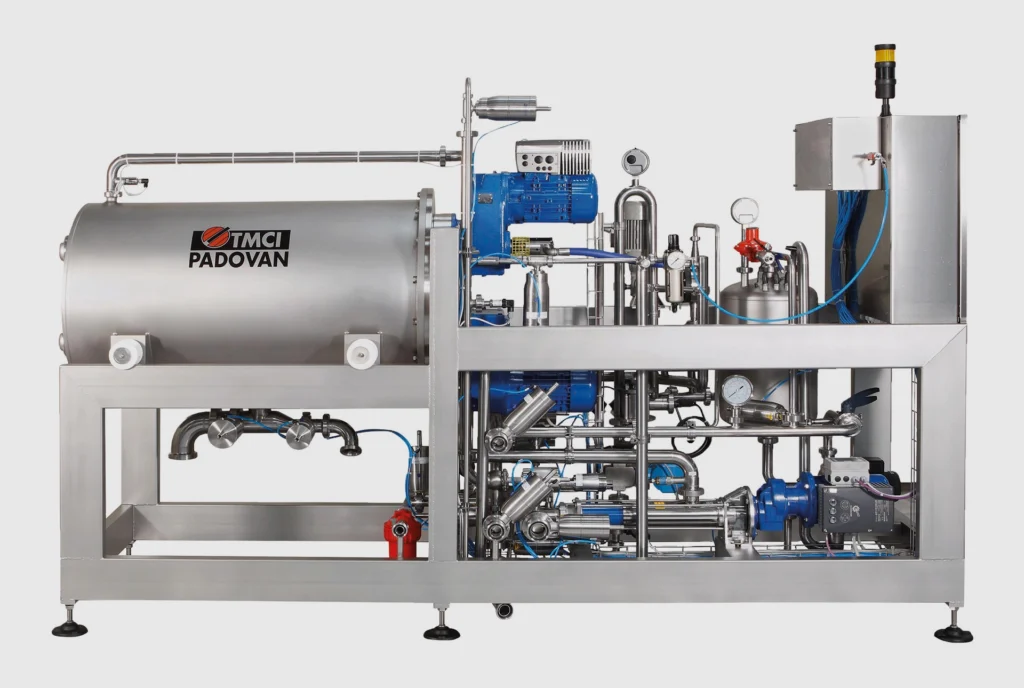
Small-scale system (approx. 0.1 m²): ideal for laboratory testing, manual operation, low material requirements
Larger system (up to ~2 m²): simulates production scale, touchscreen operation, automatic control, variable operation
This allows you to test your liquids under real-world conditions, adjust parameters, and gather reliable data for your planning.
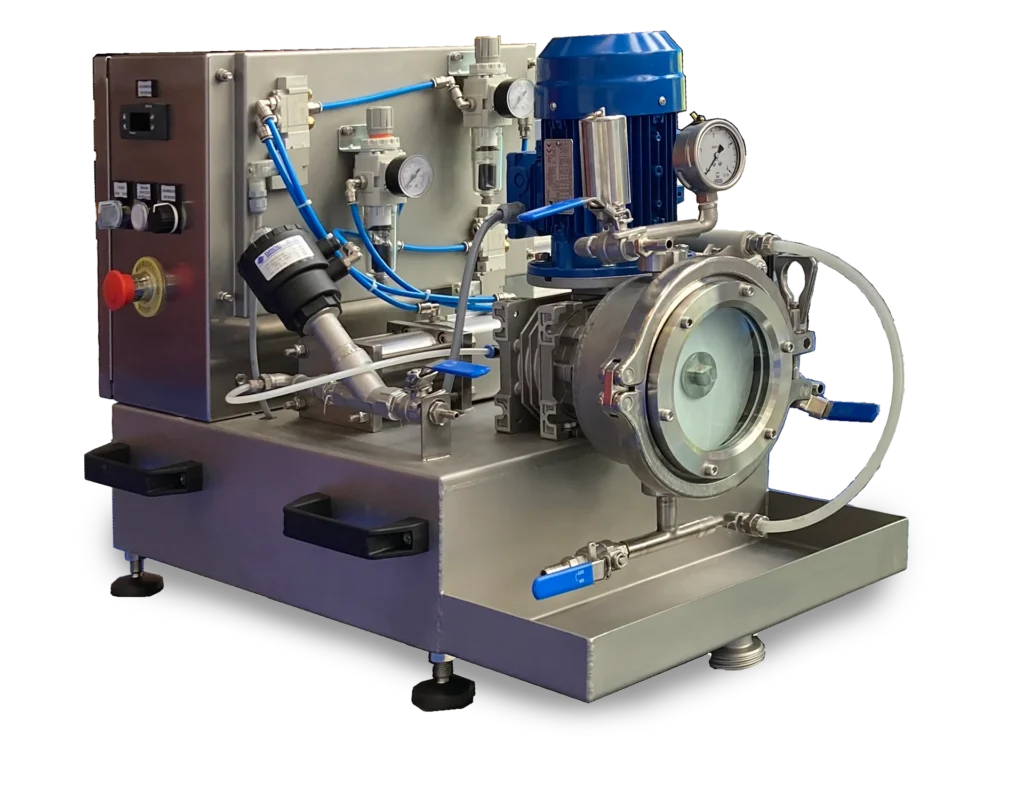
Advantages of the small system (0.1 m2)
- Ideal for initial laboratory tests
- Simple manual operation
- Only small quantities of raw material required
- Quick change of discs (testing different pore sizes)
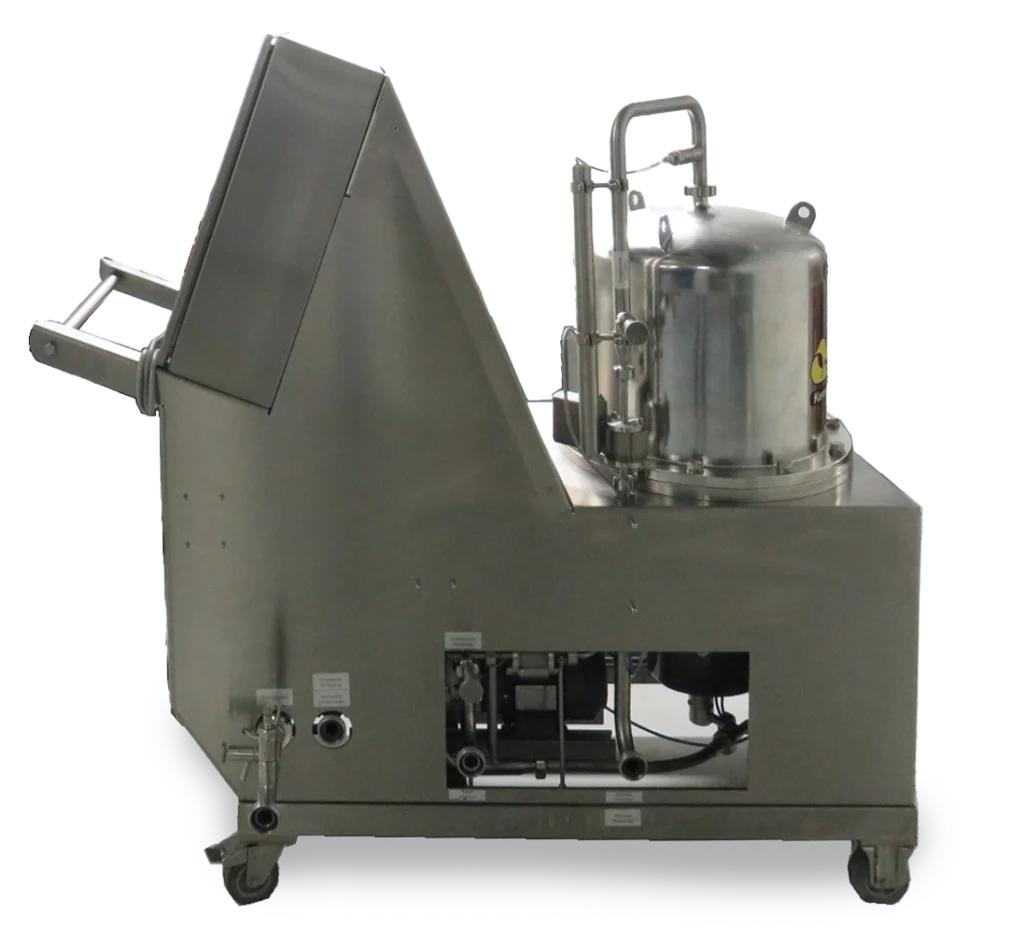
Advantages of the large system (2 m2)
- Ideal for simulating a production scale
- Simple operation via touchpad
- Automatic or manual operation
- Various setting options
- Automatic emptying at the desired concentration level
- Can be fitted with fewer discs
Contact / Consultation
Would you like to learn more, start a project, or rent a test facility?
Contact us—we’d be happy to assist you:
Contact:
Christian Münch, M.S. in Physics, & Franz-Martin Fuchs, M.S. in Engineering
Phone: +49(0) 9645 – 88 610 / +49(0) 9645 – 88 430
Email: keramik@kerafol.com
Or fill out our contact form and let us know your application, desired throughput rates, or technical requirements—we’ll get back to you right away.